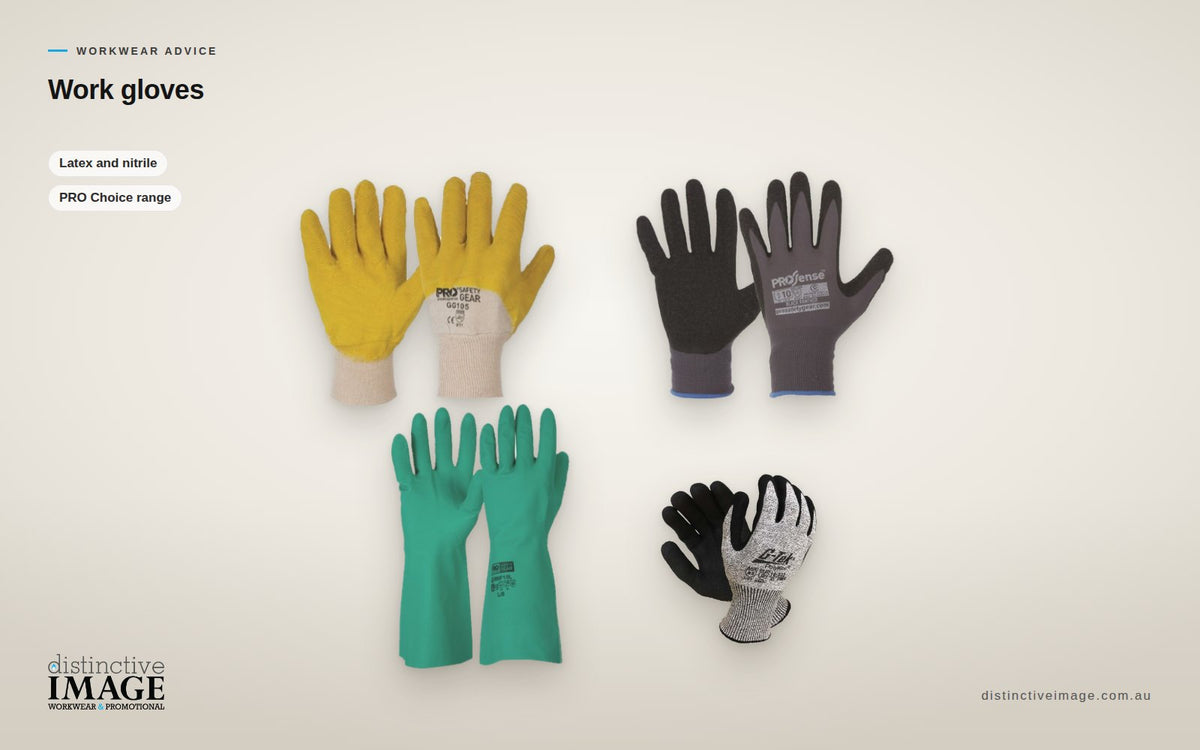
A work glove does one main job well: grip, cut resistance or keeping liquids off your hands. The coating on the palm decides most of the grip, a tested rating tells you about cuts, and chemical protection depends on the exact chemical you're handling. Start with the job, then read the listing for what the glove actually states. If it doesn't state a rating, don't assume one.
Grip: what the coating does
Many of the gloves we list are a knitted liner dipped in a coating. Here's what each coating's listing says about grip.
| Coating | Glove | The listing says |
|---|---|---|
| Latex | Glass Gripper GG105 | "Good for wet and dry grip" |
| Latex | Black Panther | "extra grip and abrasion resistance" |
| Nitrile foam | Maxipro | Grip "in wet & dry conditions" |
| Nitrile sand grip | Sand Grip | "Ultra thin nitrile sand grip palm" |
| PU | Prolite | For "small parts handling" |
| PVC foam | Stinga | "water repellency" and grip |
A thin coating on a fine knit keeps more feel in your fingertips, which is why the Prolite and Maxipro suit fiddly work. The Maxipro listing also says it "Can be used with touch screens". If anyone on your crew is sensitive to latex, look at the nitrile, PU and PVC options and check with them first.
Glass gripper gloves for brick, tile and glass
The Latex Glass Gripper GG105 has a "Latex rubber ripple palm", an open back for ventilation, a cotton jersey liner and a knitted wrist. Its listing names brick handling, glass, tile and ceramics, landscaping and labouring. It doesn't give a cut rating, though, so if your risk assessment calls for cut protection when handling glass or sheet edges, look at a cut-rated glove instead.
Reading an EN 388 code
EN 388 is the European standard for protection against mechanical risks, and AS/NZS 2161.3 is the Australian and New Zealand version. The 2005 edition quoted on our listings matched the 2003 EN 388, which used four numbers and no cut letter, and it has since been replaced by a 2020 edition. A glove tested to it carries a row of numbers, and each position stands for a different test. In order, they are abrasion, blade cut, tear and puncture, and a higher number means a better result in that test.
The Black Panther listing gives "Certified to EN388 AS/NZS 2161.3:2005 Protection Against Mechanical Risks Results - 3121". Read in that order, that's 3 for abrasion, 1 for blade cut, 2 for tear and 1 for puncture. So it's a hard-wearing grip glove, not a cut glove. The Riggamate cowhide rigger listing quotes the same standard but doesn't give its results, so ask us before relying on it for a particular rating.
Cut levels
Newer EN 388 markings add a letter from A to F for cut, from a separate cut test, with F the highest. The G-TEK Polykor Cut C listing says "Cut rating level C for light to medium Cut Hazard Risks". It doesn't name the standard behind that letter, and other cut scales are in use, so check the marking on the glove against what your risk assessment asks for. Of our glove listings, the G-TEK is the only one that gives a cut letter.
Chemical gloves
Chemical resistance is rated chemical by chemical. A glove that keeps one solvent out can let another through quickly, so there's no such thing as a glove that's safe for "chemicals" in general. The test results that matter are the maker's data for the exact chemical on your safety data sheet (SDS), usually reported under the European chemical glove standard, EN ISO 374.
None of our glove listings quotes EN ISO 374 or gives chemical test results. Here's what they do say:
- Nitrile Chemical Gloves 33cm: "Premium grade nitrile for maximum abrasion and chemical resistance", a flock lining and a textured palm, in sizes S/6 to 3XL/11.
- PVC Double Dipped and PVC Single Dip: "Resistant to oil and grease", 27cm long and one size fits all.
- Silverlined Latex Rubber Household Gloves: listed as "food handling gloves", with a nitrile blend "for improved fat and abrasion resistance".
Before anyone uses any of these with a chemical, read the SDS and get the maker's chemical test data for that product. We won't tell you a glove suits a chemical unless the maker's test data covers it.
Sizing and small extras
Most coated gloves we list come in numbered sizes, from 6 or 7 up to 11 or 12, and most are sold 12 pairs to a pack. The Riggamate cowhide glove has a "Colour coded cuff for size identification", which helps when a crew's gloves end up in one bin. If people keep losing gloves, the PRO Choice Glove Keeper clips to a belt loop or pocket, and its link arm is "designed to breakaway in the event of glove entanglement".
Putting together kit for a warehouse or dock team? Our warehouse and logistics uniform kit list covers the hi vis tops, vests, pants and warm layers that go with the gloves.
Browse our full gloves range, or tell us the job and we'll help you shortlist through our custom workwear enquiry form.